Regional scent preferences exist, but they behave like a distribution rather than a rule. Climate, retail assortments, gifting habits and format conventions all shape what sells in East Asian markets, and none of them reduces to a single note direction. Product teams get further with a short list of assumptions to test locally than with a stereotype to design around, because the cost of testing is small and the cost of a wrong assumption is a full production run.
Key takeaways
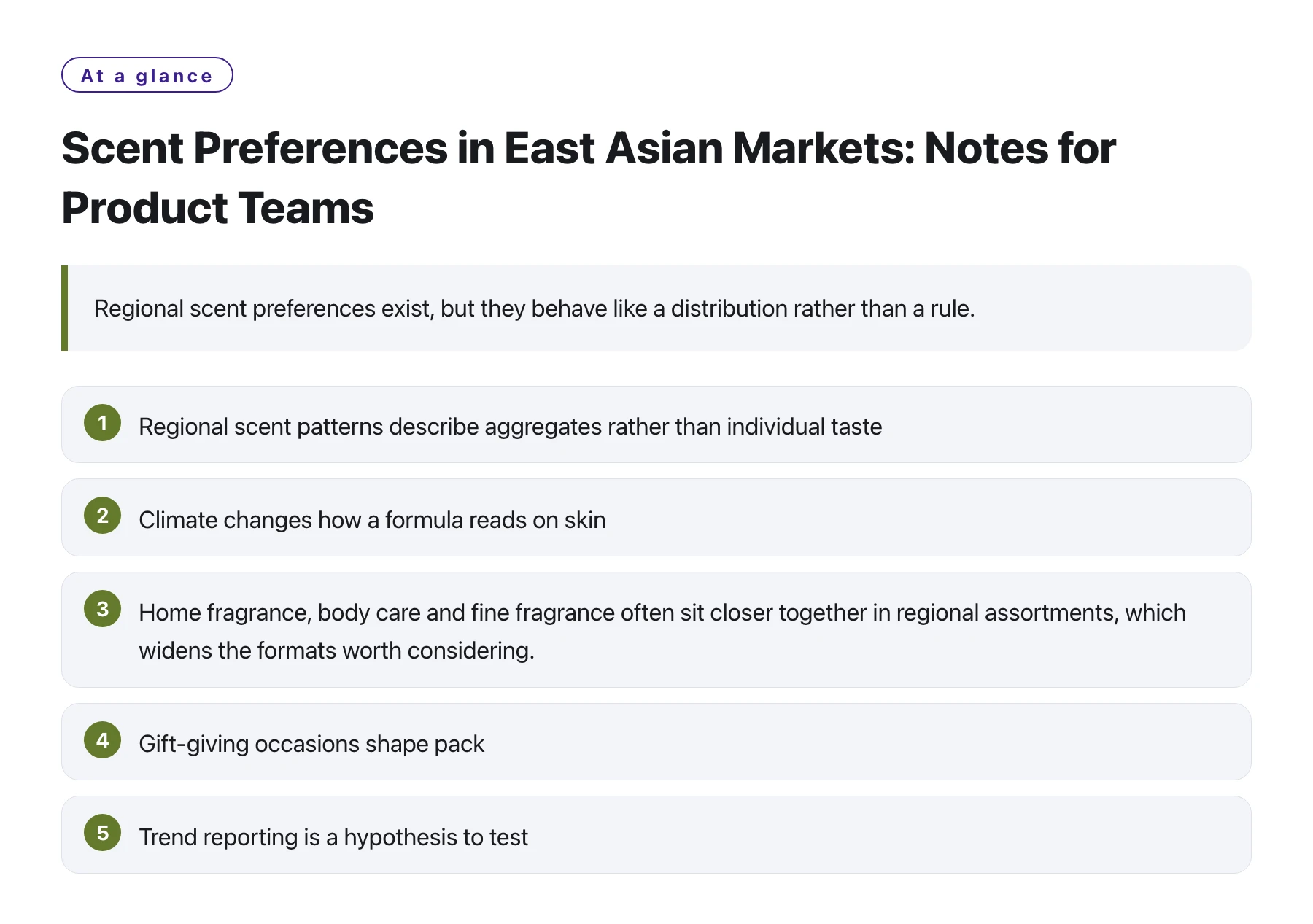
- Regional scent patterns describe aggregates rather than individual taste, so any direction still needs local wear testing before a launch decision.
- Climate changes how a formula reads on skin, which is why the same juice can feel heavier in a hot, humid market than in a temperate one.
- Home fragrance, body care and fine fragrance often sit closer together in regional assortments, which widens the formats worth considering.
- Gift-giving occasions shape pack, price tier and purchase timing, so packaging belongs in the market plan rather than after the formula is approved.
- Trend reporting is a hypothesis to test, not a specification to build to, and local retail checks are the cheapest way to challenge it.
Ask five people to describe the East Asian fragrance market and you will get five confident answers, most of them built from a handful of trend articles and one retail visit. The market is large enough that any generalisation has an example behind it, which is exactly what makes generalisations dangerous.
A more reliable approach is to treat regional patterns as hypotheses and design a validation sequence around them. That sequence is what this guide sets out.
Why regional taste resists simple rules
Three factors do most of the work in shaping how a fragrance line lands in a region: the physical conditions it is worn in, the assortment it sits inside, and the occasion it is bought for.
Climate changes how a formula reads
Heat and humidity affect how quickly aroma materials lift off the skin, so a formula that reads as balanced in a temperate climate can feel louder in a hot, humid one and quieter in a heavily air-conditioned environment. This is physics rather than taste, which makes it the most testable of the regional factors.
It also means the answer is often a material or load adjustment rather than a completely different direction. Brands that treat climate as a wear-test variable usually keep more of their original creative work.
Assortments place categories side by side
In many regional retail environments, home fragrance, body products and fine fragrance are merchandised closer together than in markets where perfume sits in its own department. That changes which formats are plausible for a new line, and it makes a body or home extension a natural part of the initial plan rather than a later add-on.
Trend reporting describes categories, not individuals
Consumer research organisations such as Mintel publish trend work at the category level, describing shifts in how products are bought and used [1]. That is genuinely useful for framing a hypothesis, and it is not a substitute for observing shoppers in the market you intend to sell in.
The practical discipline is to write each trend down as a testable statement, then design the local work that could prove it wrong.
Assumptions worth testing locally
| Assumption | Why it circulates | How to test it locally | What the answer changes |
|---|---|---|---|
| Lighter profiles always travel better | Warm, humid climates change how strongly a formula reads | Wear tests in local conditions with more than one wearer | Load and material balance rather than the whole concept |
| Sweet, dessert-inspired directions are universally popular | Global trend reporting highlights gourmand profiles | Compare against current local category bestsellers | Sweetness level and the amount of supporting material |
| Alcohol spray is the default format | Fine fragrance conventions dominate industry literature | Review the format mix on shelves in the target city | Whether mist, solid or home formats join the launch |
| One scent can cover the whole region | Regional reporting aggregates several distinct markets | Test in two or three cities before scaling production | Whether to localise or launch in sequence |
| Gift packaging is a secondary detail | Fragrance is frequently bought as a gift in the region | Ask how the pack reads before it is opened | Budget split between the juice and the presentation |
None of these assumptions is absurd; each one contains something true. The problem is that they are usually treated as conclusions instead of as questions, which is why the third column deserves more of the project budget than it typically receives.
Where a regional manufacturing partner helps
Once a direction has been validated, the remaining work is adjustment: materials, load, format and pack. That work goes faster with a partner who already produces for the region.
Reformulating for a market beats relaunching
The common failure pattern is an all-or-nothing response: a direction does not land, so the whole concept is abandoned and rebuilt. In practice the fix is often a material substitution or a change in the balance between the opening and the dry-down.
Fragrance houses such as Symrise publish on their ingredient portfolios and on regional market work, which is where a brand can look for materials that support a fresher or lighter positioning without losing the original character [2].
Format choices widen the plan
A manufacturer that produces fine fragrance, home fragrance and scented body products under one roof can test several formats against the same scent direction. The category lists published on Xuelei's website place home and body products beside fine fragrance, which reflects how these categories sit together in many regional assortments.
The major houses segment their businesses along similar lines, and their published material on market segmentation is a useful reminder that format and positioning are decided together [3].
A local validation sequence
- Write the assumption downState the regional belief as a sentence that could be proven wrong, including the market and the category it applies to.
- Check the shelf before the labA retail walk in the target city shows the format mix, price tiers and pack conventions faster than any report.
- Run wear tests in local conditionsEvaluate candidates on several wearers in the climate and routine the product will actually meet.
- Test the format, not just the scentThe same direction can behave differently in a mist, a lotion or a home product, so test it in the intended format.
- Scale only what survivedMove to production with the variants that held up, and keep the rest as options for a later launch.
The most common mistake in regional product planning is treating a market report as a design brief. A report can tell you that a category is growing or that a format is gaining shelf space; it cannot tell you how a specific formula reads on a specific person in a specific city. Budget for the local step, even a small one: a handful of wearers, one retail walk, one format comparison. Manufacturers that already produce for the region, including Xuelei in Guangzhou, tend to have a view on which adjustments are routine and which ones change the character of a scent, and that view is worth testing against your own.
Sources
- Mintel Press Centre —— Mintel's press releases on consumer and beauty market research, including fragrance and personal care trend reporting.
- Symrise —— A global fragrance and flavour manufacturer; public information on scent creation, raw materials and research.
- Givaudan —— One of the largest fragrance and flavour houses; public material on fragrance creation, ingredient portfolio and market segments.
Frequently asked questions
Is there really such a thing as a regional scent preference?
There are measurable regional patterns, but they describe how groups buy and wear fragrance rather than what any individual likes. Climate, retail assortment and gifting habits create real differences in which formats and intensities work. Treat those patterns as hypotheses, then validate them with local wear tests before committing to production.
Should a fragrance for East Asian markets be lighter?
Not automatically. Lighter profiles are frequently discussed because warm, humid conditions change how a formula reads, but the answer depends on the format, the occasion and the price tier. A home fragrance or a body product may carry intensity very differently from an alcohol spray, so test the actual product rather than the assumption.
How many markets can one fragrance line cover?
One direction can often serve several markets if the brief leaves room for adjustment, but the pack, the price tier and the labelling usually differ. Testing in two or three representative cities before scaling gives you a defensible base, and it is cheaper than correcting a single regional launch after production.
Do I need a local partner to launch in Asia?
Not necessarily, but a manufacturer that already produces for the region shortens the loop, because it can advise on materials, formats and documentation that local buyers expect. Ask what proportion of its work serves the region and which adjustments it makes most often.
How much does local validation cost?
Less than most brands assume, because the expensive part is production rather than testing. A small wear test, a retail walk and a format comparison can be arranged before a large order. Treat that spending as insurance against a full run built on an untested regional assumption.