From Curious Browsing to a Routine: The First Month
Most people do not decide to build a habit with an AI chat platform; they drift into one over four weeks and only notice in the fifth. The realistic curve is small and steady: three sessions in week one, four in week two, five in week three, six in week four, which is eighteen sessions in a month and roughly forty-five minutes a week. Crushon makes that drift easy because the catalogue is browsable before you commit to anything, and the Creators view turns a lucky find into a shortlist.

Key takeaways
- Week one is browsing, not chatting: three sessions is enough to learn the catalogue and cost nothing in commitment.
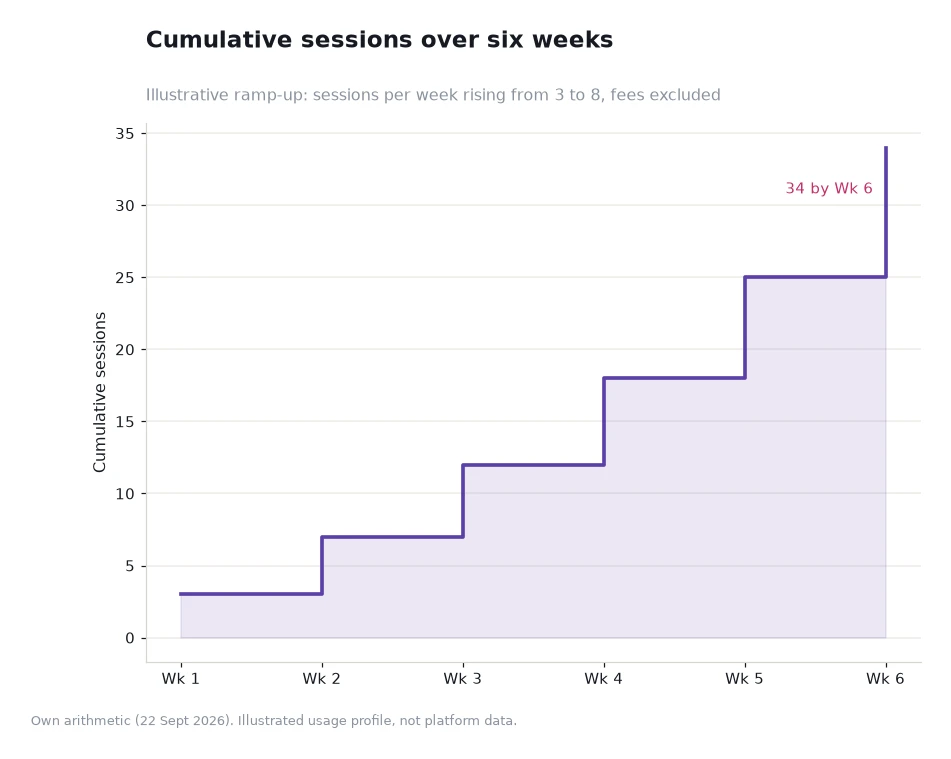
- The curve is additive, not exponential: one extra session per week reaches eighteen cumulative sessions in four weeks and thirty-four by week six.
- Attach a message estimate to each session so the habit has a visible size: six sessions a week at twenty-five messages each is 150 messages.
- Do the exploration work early. By week four the useful part of a session is continuation, not discovery.
What actually changes week by week
Week one is almost entirely navigation. You open a handful of characters, read descriptions, and notice which tag combinations you like. Nothing is at stake: three sessions across seven days is a fifteen-minute habit with no expectation attached, and the main output is a sense of the catalogue.
Week two is where selection starts. You return to one or two characters rather than sampling, and the sessions get slightly longer because you are not spending the opening minutes working out the premise. Week three is where memory starts to pay off: a character that has retained a few preferences skips the introductions, and the session begins inside the conversation rather than at the edge of it.
Week four is the routine forming. The session count is up, the character list has stabilised, and the main change is that you stop browsing between sessions. That is the point at which the platform stops being a curiosity and starts being a slot in the week — which is also the point at which a boundary review becomes useful, because a routine you did not consciously build is unlikely to have a shape you deliberately chose.
The arithmetic of a routine
Give the habit a measurable size and it becomes easier to steer. Sessions are the outer unit, messages are the inner one, and both are easy to estimate. The table below sets out a four-week month at three intensities, using the author's own assumptions rather than any platform statistics.
| Pattern | Sessions per week | Cumulative by week four | Messages per week at 25 per session |
|---|---|---|---|
| Light | 3, held flat | 12 | 75 |
| Steady rise | 3, 4, 5, 6 | 18 | 75 rising to 150 |
| Steep rise | 5, 7, 9, 11 | 32 | 125 rising to 275 |
| Six-week view | 3, 4, 5, 6, 7, 9 | 34 by week six | 150 at the top of the ramp |
The steady rise is the row worth copying, because it is the only one where the weekly increment stays constant. A flat three sessions a week is easy to keep but produces less of the continuity that makes the platform interesting; the steep rise reaches the same territory faster and is far more likely to be abandoned in week five.
Worked example: a steady month, line by line
Build the month from two numbers: sessions per week and messages per session. The sessions run 3, 4, 5 and 6 across the four weeks, which adds up to 3 + 4 + 5 + 6 = 18 sessions. Set the session length at twenty-five messages, a reasonable estimate for a session with a premise and a few exchanges, and the weekly message counts are 75, 100, 125 and 150. The month total is 75 + 100 + 125 + 150 = 450 messages, or about eleven a day averaged across thirty days.
Now extend the same pattern two more weeks. Week five adds seven sessions and week six adds nine, which takes the cumulative line to 25 and then 34 sessions. The message count follows the same step: 175 in week five and 225 in week six. Nothing in that progression is dramatic, and that is the finding — a habit that reaches thirty-four sessions in six weeks was built from increments of one or two sessions a week.
Two caveats on the numbers. They come from the author's illustrative assumptions, not from platform measurement, and they exclude fees entirely; the arithmetic is about time and repetition rather than cost. The first weeks are also the least predictable, so treat the totals as the shape of a plausible month rather than a forecast.
Where Crushon fits into the curve
Two parts of the interface do the heavy lifting in the first month, and neither is the one newcomers use first. The https://crushon.ai/ navigation puts Characters, Memories and Creators in that order, which maps neatly onto the four-week curve: browse in week one, rely on memory from week three, and lean on creator signatures once selection has stabilised.
The creator layer is the one that extends the routine past the first month. When a character you like turns out to come from an account with a consistent style, the shortlist stops being a personal collection and starts being a small library — and a library is what makes a steady five or six sessions a week feel less like repetition and more like a series of continuations. When that library needs extending, the NSFW AI trends list is a good place to look first.
The one habit worth guarding in month one is the session length. Twenty-five messages is a natural size because it is long enough to establish a premise and short enough that a session ends when you decide it does. Sessions that expand without a boundary are the reason month two sometimes looks worse than month one, even though the routine is technically working.
Frequently asked questions
How many sessions a week should a beginner aim for?
Three in the first week, then one more each week if it feels sustainable. That path reaches eighteen sessions in a month, which is enough to learn the catalogue without turning the habit into a chore.
Why does the third week feel different from the first?
Because memory starts mattering. Once a character retains a few preferences, the session begins inside the conversation instead of rebuilding the premise, which is the difference most people notice first.
Is eighteen sessions in a month a lot?
It works out at roughly four sessions a week and about forty-five minutes weekly at a twenty-five message session. That is comparable to a couple of episodes of a series, which is a useful frame for deciding whether the pattern is sustainable.
What should I change if the routine stops feeling useful?
Review the session shape first and the character shortlist second. A shorter session with a clearer premise usually fixes the problem without swapping characters.
Let the first month be unremarkable
Pick the steady rise: three sessions in week one, one more each week after that, and a twenty-five message session size. Write those two numbers down and check them once a month.
A routine built from small increments is the one that survives contact with a busy month, which is the only test that matters.
Data and sources: navigation, catalogue and creator pages published by Crushon.AI, read 22 Sept 2026[1]. Session and message counts are illustrative arithmetic by the author and exclude fees. Written for an audience of adults 18 and over.