Servicing an EV in Australia: What Owners Actually Pay
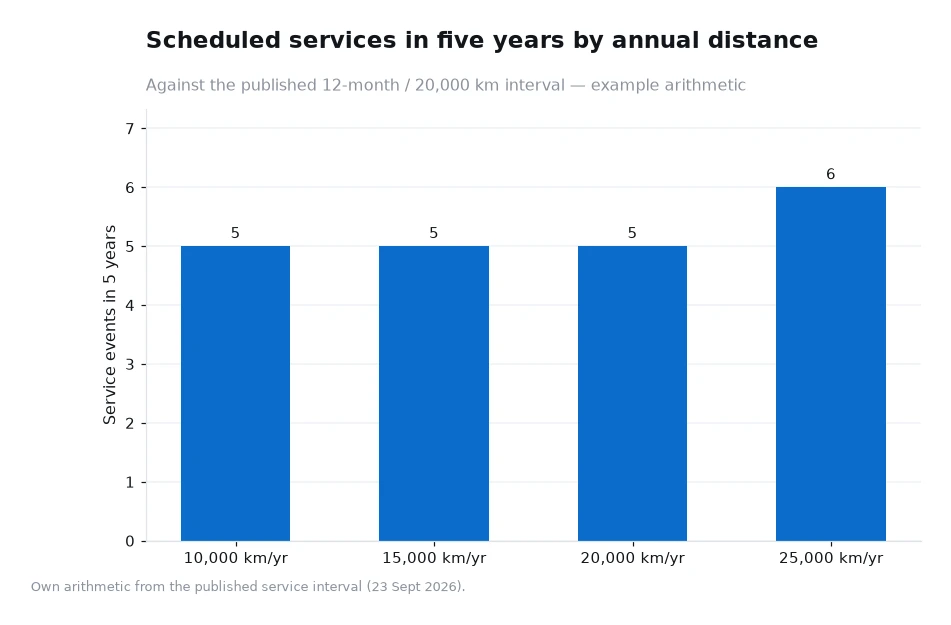
The published service interval for XPENG vehicles in Australia is 12 months or 20,000 km, whichever comes first, and that single line does more to decide your servicing bill than anything else on the specification sheet. Drive 10,000 km a year and you service on the calendar. Drive 25,000 km a year and the odometer overtakes the calendar, which adds an extra visit across five years. Neither schedule is expensive by workshop standards, but the difference is real and worth planning for.

Key takeaways
- The published interval is every 12 months or 20,000 km, whichever comes first, serviced through an XPENG Authorised Dealer.
- Across five years that means five visits at 10,000, 15,000 or 20,000 km a year, and six visits at 25,000 km a year.
- Remote diagnostics is provided as standard, and some faults can be resolved remotely rather than in a workshop.
- Whole vehicle cover runs 7 years or unlimited kilometres privately, with key parts covered for 8 years or 160,000 km.
What the Australian service schedule says
Scheduled maintenance is published as every 12 months or 20,000 km, whichever comes first. Servicing is recommended through an XPENG Authorised Dealer, and the detail sits in the owner's handbook and in the Warranty and Maintenance Manual. There is no published price list for servicing on the Australian site, which means the honest answer to "what will it cost" starts with your own annual distance and your local dealer's labour rate.
What is published is the rhythm: one visit a year for a low-kilometre owner, and a distance-driven rhythm for a high-kilometre one. The same schedule covers the New G6 and the X9, so the counting rule below applies whichever body style you choose. That rhythm is the part you can plan around, and it is the part this article works through with numbers.
Why distance, not the calendar, decides the count
Two clocks run at once. The calendar clock fires every 12 months regardless of how far you drive. The distance clock fires at 20,000 km. Whichever rings first books the visit. At 10,000 km a year the calendar always wins, so five years means five visits. At 15,000 km a year the calendar still wins, because 15,000 km is short of the distance trigger. At 20,000 km a year the two clocks arrive at the same moment, which is why that scenario still lands on five visits rather than six.
Only when annual distance passes 20,000 km does the odometer take over. At 25,000 km a year the car reaches 20,000 km before the twelfth month, so the next trigger arrives early and the five-year total becomes six visits. The same logic runs in reverse for a car that sits in the garage: a low-distance owner still services once a year, because fluids, filters and inspections are age-related as much as wear-related.
The published terms that sit alongside the schedule
| Item | Published term |
|---|---|
| Scheduled service interval | 12 months or 20,000 km, whichever comes first |
| Service location | XPENG Authorised Dealer |
| Whole vehicle warranty, private use | 7 years / unlimited km |
| Key parts warranty (traction battery, BMS, drive motor, IPU) | 8 years / 160,000 km |
| Traction battery capacity floor during the key parts period | Minimum 70% of original capacity |
| Roadside assistance | 7 years from first registration |
What is checked at a visit
A service visit on an elctric suv is mostly inspection rather than replacement. There is no engine oil to drain, no oil filter and no spark plugs, so the labour list is dominated by checks: brakes and fluid, coolant, cabin filter, tyres and pressures, suspension and steering, high-voltage system condition and a diagnostic scan of the control modules. Brake pads tend to last longer than on a comparable petrol car because regenerative braking does much of the slowing, though that also means the pads can stiffen from underuse, which is one reason an annual inspection still matters on a car that lives in the city.
The other thing a dealer visit does is log the service history. The warranty is written around vehicles imported into Australia by the official importer and registered here, and the manual is explicit that conditions and exclusions apply. Keeping the stamped record makes any later claim a paperwork exercise rather than an argument.
Remote diagnostics and the Owner's App
Remote diagnostics is provided as standard for all XPENG models. Specialists can assess the root cause and the data behind a fault quickly, and depending on the issue, they can sometimes resolve it remotely, which saves you the trip to a workshop entirely. The XPENG Owner's App is the booking layer: it lets you schedule maintenance and other services at dealerships and times that suit you, and it keeps the record in one place. The owner services hub sets out the same structure, and the roadside assistance page carries the emergency number for the seven-year assistance period.
In practice, remote diagnostics changes the shape of ownership costs rather than replacing servicing. A warning light that never becomes a workshop visit is a saving of both time and money, and a fault that is caught early is usually a cheaper fault. The scheduled visit is still the backbone.
Worked example: five years of servicing at 15,000 km a year
Every number below except the interval itself is a labelled assumption for illustration, not a manufacturer figure. Assumptions: 15,000 km a year, a service visit costing $320 in labour and parts, one set of tyres over the five years at $1,000, and no warranty repairs, because those would be covered under the published key parts terms.
Distance first. 15,000 km a year means 75,000 km across five years. Against the published interval, the calendar trigger fires every year, so the visit count is 5, and the chart on this page shows exactly that — five events at 10,000, 15,000 and 20,000 km a year, and six at 25,000 km a year.
Cost next. Five visits × $320 = $1,600. Add the assumed tyre set: $1,600 + $1,000 = $2,600 over five years, or $520 a year. Per kilometre, $1,600 ÷ 75,000 km = $0.021 for scheduled servicing, which is about 2.1 cents per kilometre. Run the same assumptions at 25,000 km a year and the servicing total rises to 6 × $320 = $1,920 across 125,000 km, which is $0.0154 per kilometre — more visits, but each one is spread over more distance. That counter-intuitive result is why cost per kilometre beats cost per visit as a planning measure.
Frequently asked questions
Do I have to service the car at a dealer to keep the warranty?
The manufacturer recommends servicing through an XPENG Authorised Dealer and sets the interval at 12 months or 20,000 km, whichever comes first, with the conditions and exclusions listed in the warranty and maintenance manual.
How much should I budget each year for servicing?
There is no published price list, so treat any figure as your own input: at an assumed $320 a visit and one visit a year, the yearly amount is $320, and the important habit is keeping to the interval rather than the amount.
Planning your first five years
Put your annual distance next to the interval and the answer falls out. Under 20,000 km a year, plan on one visit a year; over it, plan on the extra event the odometer triggers. Then write your own numbers into the blank where this article used $320, because local labour rates vary and the manufacturer publishes no service pricing.
Book the first service through the Owner's App as soon as you have a delivery date, and ask the dealer to print the service record each time. Two minutes of filing now is what makes a warranty claim straightforward later.
Servicing terms and warranty figures come from the manufacturer's Australian site at xpeng.com/au, read 23 Sept 2026. The $320 visit cost, the $1,000 tyre set and the annual distances are illustrative assumptions for the worked example, not manufacturer data, and no model price is quoted because none is published.[1]