Changing Pools Without Losing Your Baseline
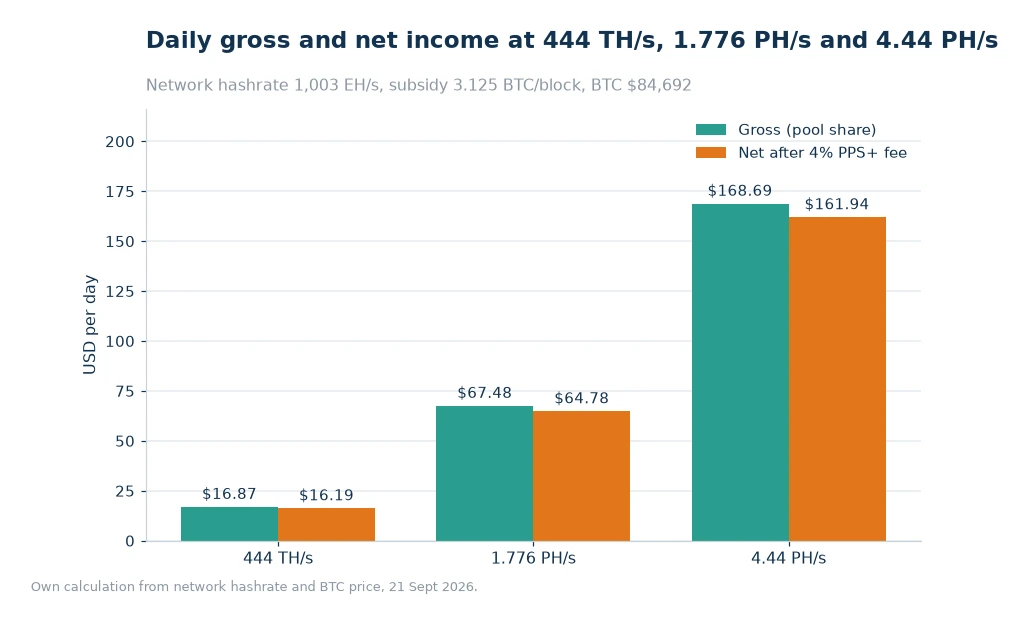
A 444 TH/s rig should produce 0.00019918 BTC on a full day at the values read on 21 Sept 2026, which is $16.87 gross and $16.19 net. The hard part of moving that rig to a new pool is not the configuration. It is keeping a comparable record across the change, so that week two can be judged against week one instead of against a feeling.
Key takeaways
- 444 TH/s is worth 0.00019918 BTC a day, or $16.19 net after the listed block-reward charge.
- Seven days at that rate comes to 0.00139426 BTC, about $113.33 net, which is a usable comparison window.
- Freeze a seven-day baseline on the old pool before cut-over, in coins and in dollars.
- Under PPS+ the first hour produces a credit; under PPLNS the first day can look empty while confirmations catch up.
What a pool switch does not change
The hardware stays. The circuit stays. The heat, the noise and the payout address stay. What changes is who credits the shares and how the credit is shaped. That is a narrow change, and it is worth stating plainly because a switch that feels like a fresh start tends to produce a fresh spreadsheet, which is exactly how a baseline gets lost.
Keeping the same worker naming scheme across the move also helps. If the old pool called the machine rack-b-unit-2, use the same name on the new one. A year from now the name will be the only thread connecting two histories, and a rename costs nothing today but makes an old statement unreadable later.
The week before: freeze a baseline
Seven days is long enough to smooth a weekend and short enough to remember. Record four things on the old pool: total coins credited, total value at a stated price, the hashrate the pool reported, and the settlement method in force. Write the dates down. A baseline without dates is an anecdote.
Do not stop at the total. Note the number of credits and their spacing, because that pattern is the fingerprint of the old scheme. Under PPS+ you should see a steady series of hourly entries on the block-reward side. Under PPLNS you will see gaps and then a lump after six confirmations. Knowing the old pattern makes the new one easier to read.
Two schemes, two shapes of first week
The ViaBTC Mining Guide describes the setup screens and the settlement options, and reading it before cut-over is cheaper than reading it while a machine idles. The two methods behave differently in the first 24 hours, and a miner who expects the wrong shape will think something is broken.
PPS+ is the default. It settles the block-reward component hourly against current difficulty at a listed 4%, and routes the transaction-fee component through PPLNS logic at a listed 2%. The first week looks almost boring, which is the point. PPLNS applies a listed 2% to the combined amount and pays after six confirmations, sharing your slice across the previous five difficulty rounds. Its first day can be quiet and its third can be fat.
If the old pool paid in one scheme and the new one uses the other, the comparison window should be longer than a day. A single day under PPLNS is a sample of a five-round window, not a verdict on the pool.
A seven-day record you can compare
The table is a template, not a prediction. The expected column uses the 444 TH/s arithmetic so the record has something to check against, while the record itself comes from the statements on both sides of the change.
| Point in time | What to write down | Expected at 444 TH/s | Why it matters |
|---|---|---|---|
| Day −1 | Old pool's seven-day coins and value | Your own baseline, not this table | Gives the switch something to beat |
| Day 0 | Cut-over hour and worker name | First accepted share timestamp | Attributes the two histories correctly |
| Day +1 | First full day on the new pool | 0.00019918 BTC, $16.19 net | Confirms delivered hashrate |
| Day +7 | Seven-day total, coins and dollars | 0.00139426 BTC, $113.33 net | Compares like with like |
The Day −1 row is the one people skip. Without it, the Day +7 figure has no counterpart, and the switch becomes an article of faith rather than a measurement.
Worked example
Rebuilding the expected values so the record can be checked by hand:
- Daily issuance: 144 × 3.125 = 450 BTC.
- 450 split by 1,003,000,000 gives 0.00000044865 BTC per TH/s per day.
- Rig output: 444 × 0.00000044865 = 0.00019920 BTC, recorded as 0.00019918.
- Gross: 0.00019918 × 84,692 = $16.87.
- Net at the listed 4% on the block-reward part: 16.87 × 0.96 = $16.19.
- Seven days in coin: 0.00019918 × 7 = 0.00139426 BTC.
- Seven days in dollars: 16.19 × 7 = $113.33; four such rigs would produce 4 × 0.00019918 = 0.00079672 BTC a day, or $64.78 net.
What to do when the first week looks worse
First, check the scheme. A PPLNS week that includes a slow confirmation period can trail a PPS+ baseline without anything being wrong. Second, check the delivered hashrate on the new pool and compare it with what the old pool reported for the same machine. Third, check the fee lines against the schedule, because a mis-set sub-account can apply a rate that was never intended.
Only after those three checks is it worth comparing totals. Most disappointing first weeks resolve at step one or two, and the ones that do not usually turn out to be a record-keeping problem rather than a revenue problem.
Setting the comparison date
Choose the date in advance and write it down. Fourteen days is a sensible default for a like-for-like comparison, because it covers two difficulty adjustments and at least one full PPLNS window. A date chosen after the fact tends to be the best day of the month, which is not a comparison at all.
At the chosen date, put the two seven-day totals side by side in coins first, then in dollars at the same price. Coins remove the price effect; dollars tell you what the household experienced. Looking at both prevents the classic mistake of crediting the pool for a good week in the market.
Write a sentence explaining any gap larger than a few percent. The sentence is the difference between a record and a pile of numbers, and it is the part you will read in six months when the same question comes up again.
Frequently asked questions
How long before a switch can be judged?
Fourteen days is a reasonable default, covering two difficulty adjustments and a full PPLNS window, with a seven-day checkpoint in between.
Should the comparison be in coins or dollars?
Both. Coins isolate the pool's contribution, while dollars at a single stated price show what actually landed in the wallet.
What does 444 TH/s produce in a week?
0.00139426 BTC at the 21 Sept 2026 inputs, worth about $113.33 net after the listed 4% on the block-reward component.
Keep the baseline when you keep the account
A pool switch is a change of counterparty, not a change of physics. The hashrate, the circuit and the arithmetic all travel with the machine, and so should the record. Keep the old statements, keep the worker names, and put the new history on the same page as the old one, so the two histories can be read together.
Watch the first fortnight on the pool statistics page and keep the withdrawals in the wallet until the comparison is done. A baseline that survives the move is worth more than a fast start. Two weeks of patient notes will outlast any first-day impression.
Sources: the ViaBTC guide, pricing, statistics and wallet pages for setup, rates and network inputs[1]. Snapshot of 21 Sept 2026: 1,003 EH/s network hashrate, 3.125 BTC per block, 144 blocks daily, BTC $84,692. Published 24 Oct 2026; expected values assume constant difficulty and full uptime.