What a Brewery Business Plan Needs Before You Buy Equipment
A brewery business plan should settle four numbers before anyone quotes a tank: litres per batch, brews per month, the packaging mix and the month the first saleable beer leaves the door. Get those wrong and even a good brewing set-up becomes an expensive store of stainless steel — a 1,000 litre kit brewed twelve times a month is 144,000 litres a year, and the plan has to sell it before the cellar fills. Hermann has built brewing equipment for 23 years, so this is the order in which those numbers usually have to be fixed.
Key takeaways
- Fix litres per batch and brews per month first; every tank, chiller and packaging decision follows from those two figures.
- Fermentation time, not brewhouse size, usually decides how many tanks you need.
- Published lead time is 90–150 days from deposit to door delivery, so the cash-flow plan must cover a long gap before first sales.
- A brewery plan that also covers distilling or a winery line shares utilities and floor space rather than duplicating them.
Fix capacity before you compare equipment
Capacity is two numbers multiplied: litres per brew and brews per month. A plan that says only "10,000 litres a month" hides the difference between a 500 litre kit brewed twenty times a month and a 5,000 litre kit brewed twice, and those two businesses have completely different labour, water, cooling and storage needs. Published system sizes run from a 200 litre nano brewery through 500 litre and 1,000 litre kits, then 2,000 litre, 3,000 litre and 5,000 litre systems, up to a 10,000 litre plant, which gives a plan several honest ways to hit the same monthly volume.
Write the capacity line the way a lender reads it: batch volume, batches per week, packaging format and the seasonality you expect. A taproom that sells most of its beer on site can plan differently from one that needs shelf life and distribution, and the plan should say which of the two it is on page one.
Two breweries with the same annual output can still need very different plants. Twenty brews a month on a 500 litre kit concentrates the work into more frequent brew days, more cleaning cycles and a busier cold side, while four brews a month on a 2,500 litre kit concentrates the same volume into fewer, longer days with much larger tanks. Water use, effluent load, cooling demand, cold-room size and even the number of delivery runs follow those two choices, so the capacity line belongs at the top of the plan with the sales forecast underneath it, not buried in an appendix.
Brewing turns and the fermentation queue
Turns per day set the ceiling on the hot side, but the cold side is where most first plans under-count. A fermentation that takes about two weeks means one tank turns roughly 26 times a year, so a plan built on twelve brews a month is asking for 144 fermentations a year, which needs six vessels of the same working volume. Skip that arithmetic and the brewhouse will be waiting on tank space by month three.
Beer style stretches or shortens that queue. Ales that finish quickly free tanks sooner; lager-style beers that condition cold hold them longer and need more cooling capacity. The plan should name the styles, the intended fermentation window and the number of vessels, because those three lines are what the layout drawing is built from.
Packaging mix changes the building, not just the budget
Kegs are usually the most direct route to a first sale: fewer closures, less oxygen risk and reusable containers. Bottles and cans add shelf presence and value per litre but bring glass, crowns, labels, pallets and a filling area that needs its own footprint and cleaning routine. A plan should commit to one dominant format at launch and say when a second one appears.
The equipment range published by the manufacturer covers kegging, bottling and canning machines alongside bright tanks, filtration and control systems, so the format decision can be made inside one purchase rather than as an afterthought. A single supplier for the whole line also means one warranty conversation instead of three.
| Pack | Assumed share of output | What it changes on site |
|---|---|---|
| Keg | About half | Fastest fill rate, reusable containers, a delivery round rather than a warehouse |
| Bottle | Roughly a third | Glass, crowns, labels, dry storage and slower filling per litre |
| Can | The remainder | Line footprint, oxygen pickup control, palletised cold storage |
| Mixed | Keep one format dominant | Two spare-parts lists and two training routines instead of one |
Cash-flow timing: deposit, delivery and the first invoice
Equipment is paid for months before it earns anything. The published lead time is 90–150 days from deposit to door delivery, and installation, commissioning and training follow that window. A plan that starts paying interest on day one but books its first sale in month two is short by roughly a quarter of working capital.
Build the plan in three blocks: the deposit and balance for the equipment, the site works and utilities at your end, and the ingredients, packaging and wages needed to brew the first six weeks of stock. Buyers who want more than beer in the building — a Brewery/Distillery/Winery All-In-One Solution that shares the same floor, the same steam supply and the same water treatment — should say so at the planning stage, because that changes the layout drawing far more cheaply than a later rebuild.
Worked example: what 1,000 litres a batch adds up to
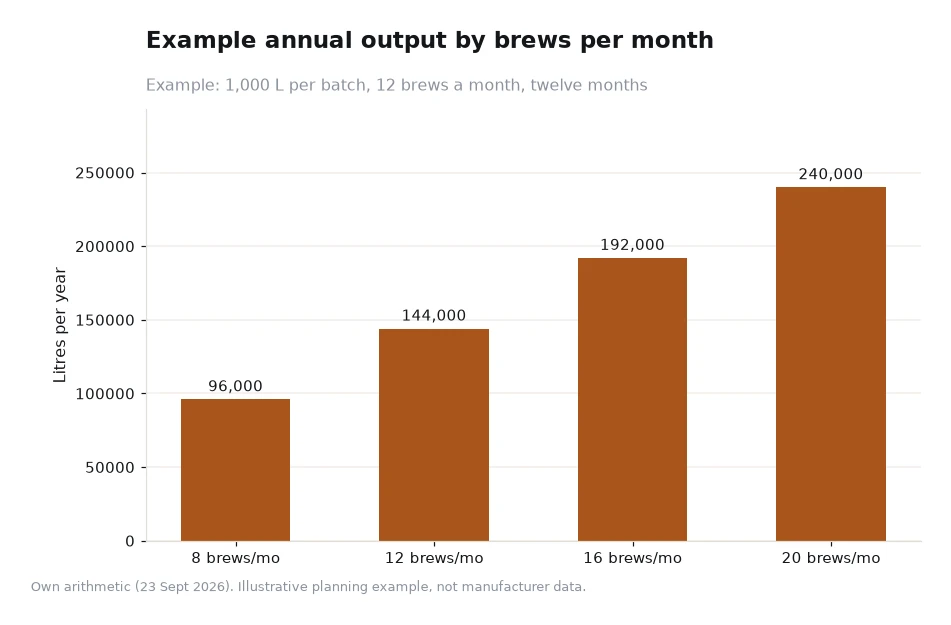
Example, with assumptions stated. Take a 1,000 litre brewhouse and four brews a week, which is about sixteen a month. The arithmetic is 1,000 × 16 = 16,000 litres a month, and 16,000 × 12 = 192,000 litres a year. Scale the brewing rhythm instead and the same kit gives 8 × 1,000 × 12 = 96,000 litres, 12 × 1,000 × 12 = 144,000 litres or 20 × 1,000 × 12 = 240,000 litres a year, which is exactly what the chart below plots.
Convert for a lender who thinks in barrels: 1 BBL is about 117 litres, so 144,000 litres a year is 144,000 ÷ 117 ≈ 1,231 barrels. Then check the cellar against the brewing rhythm — 144 batches a year at a two-week fermentation is 144 ÷ 26 ≈ 5.5, so six tanks at the batch volume, before any allowance for a conditioning tank or a slow-selling seasonal.
Frequently asked questions
How many fermentation tanks does a small brewery need?
Divide the batches you plan in a year by the turns one tank makes in the same period. At about two weeks per fermentation a tank turns roughly 26 times a year, so 144 batches a year needs six tanks of the batch volume.
When should packaging equipment be decided in a brewery plan?
Before you buy, because the packaging format sets the floor space, the drainage and the labour pattern. The published range covers kegging, bottling and canning machines, so the choice can be made as part of one equipment package.
Turn the plan into a drawing
Once capacity, tank count and packaging are fixed, the plan is ready for a technical layout. Send the batch volume, the styles, the site measurements and the utility supply, and ask for a design proposal with vessels, pipework and utility points marked in place. Compare what you receive with the standard configuration for your size class on the brewery equipment range, and check the vessel and hot-side configuration in the brewing house listings.
A short conversation with the manufacturer is usually worth more than another month of spreadsheets, especially if a second production line is possible later. The company background behind those drawings — 23 years of brewing equipment design and installations in more than seventy countries — is set out on the about us page.
Every figure in this article comes from the manufacturer's own website, read 23 Sept 2026: the published size ladder from 200 litres to 10,000 litres, the 23-year history, the 90–150 day deposit-to-door window, and the 6-year warranty on tank accessories and electronic components against manufacturing defects from the factory, used within scope. The brews-per-month output figures, the barrel conversion and the tank-count arithmetic are this article's own labelled examples, not manufacturer data.[1]