Pre-order factory checks help buyers test whether a supplier can meet a defined order, but only when the scope and decision are clear. Identify the product, required capacity, quality risks, evidence, and authority before a site visit or remote review. Distinguish business identity checks, capability assessment, management-system auditing, sample evaluation, and production inspection. Each answers a different question and should produce a recorded result that informs the next procurement decision.
Key takeaways
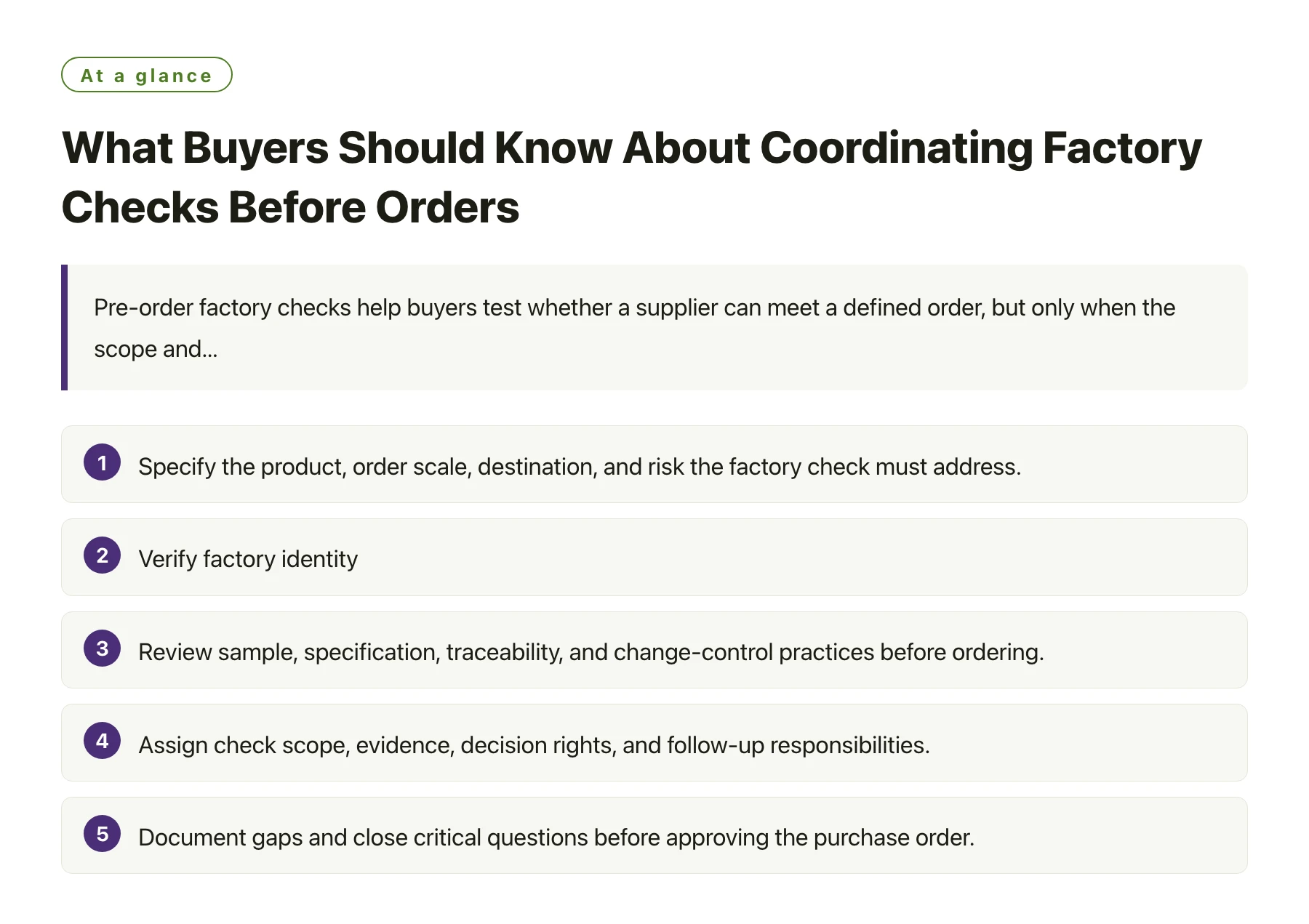
- Specify the product, order scale, destination, and risk the factory check must address.
- Verify factory identity, relevant capacity, equipment, staff, and production controls.
- Review sample, specification, traceability, and change-control practices before ordering.
- Assign check scope, evidence, decision rights, and follow-up responsibilities.
- Document gaps and close critical questions before approving the purchase order.
Treat a factory check as one part of supplier qualification, then connect its findings to the order decision.
1. Define the check and the procurement gate
Write the question the check must answer: can this site produce the specified product at the planned volume, under the required controls, within the target schedule? Identify which findings would prevent an order, require remediation, or need a specialist review. A general factory tour can be useful context, but it does not automatically establish product capability, market compliance, or future delivery performance.
Choose the review type accordingly. A business identity check confirms entity details; a capability review examines equipment and process; a management-system audit evaluates a system; a product sample review checks defined characteristics; and a production inspection looks at goods from an order. ISO 19011:2026 gives guidance for management-system audits and auditor competence, but that kind of audit is distinct from product acceptance. [1]
2. Confirm the site and operating model
Match the legal supplier name, factory address, export entity, and proposed production location. Ask whether any processes are subcontracted and how the supplier controls those sites. Verify who owns or operates the plant and which team will manage the order. If a trader coordinates production, identify the actual maker and the contractual party responsible for requirements, records, and corrective action.
Confirm the visit or remote review covers the site that will produce the quoted item. Ask for a process map, product flow, and explanation of where the critical operations occur. Record any access limit or area not observed. A short tour should not be presented as a full audit if time or access prevents examination of planned controls.
3. Compare capability with the actual specification
Give the factory the approved product brief, drawings, tolerances, materials, finish, packaging, forecast, and delivery window. Ask how it will translate those inputs into production instructions and what questions remain. Observe whether relevant machinery, fixtures, tooling, test equipment, and trained personnel are available for the specific product. A generic equipment list may not show whether the plant can meet the required tolerance or finish.
Check current workload, line capacity, minimum run, raw material access, setup time, and shift arrangements against the proposed order. Ask which assumptions the capacity estimate uses and whether the line also serves other buyers. Record bottlenecks, planned maintenance, and seasonal peaks. If a target date depends on overtime or reserved materials, include that condition in the quote and purchase plan.
4. Review quality controls and traceability
Ask how incoming materials are identified and approved, which process parameters are controlled, how operators recognize nonconforming goods, and who can stop production. Request examples of inspection records linked to product and lot, including actual results rather than a blank form. Determine how test equipment is maintained and how failures trigger containment, root-cause work, corrective action, and verification.
Check that the supplier can trace a finished unit, panel, batch, or carton to relevant material and production records. Ask how long records are retained and how the buyer can access them. A certificate shown in a meeting should be recorded with its scope, issuing body, date, and verification status. Do not treat a general quality certificate as proof that the particular order will satisfy all agreed requirements.
5. Evaluate samples and engineering communication
Review a representative sample against measurable requirements and identify what remains provisional. Record model, revision, material, finish, dimensions, assembly, functional checks, and any packaging differences. Ask whether sample components are production-intent or hand-finished prototypes. Agree who signs approval and whether the factory must retain a reference sample for production comparison.
Discuss how the factory handles unclear drawings, tolerance conflicts, substitutions, and buyer changes. Request a sample change form or documented question process. Make sure a buyer’s informal comment cannot be mistaken for final approval. If translation is needed, keep the approved technical term and diagram beside translated instructions, and confirm which version the production team will use.
6. Assess safety, compliance, and ethical risks
Identify destination-specific requirements and product hazards before the purchase order. Ask what evidence exists for material restrictions, safety tests, labels, and required technical files. Assign interpretation to a qualified compliance owner; a factory visit can collect evidence but does not itself determine legal conformity. Record gaps and whether a third-party laboratory, notified body, engineer, or local counsel is needed.
Set expectations for worker safety, environmental controls, subcontracting, and business conduct that are relevant to the order and applicable standards or law. Request evidence proportionate to the risk and agreed code. Separate a verified observation from an allegation or supplier explanation. If a serious concern is identified, follow the buyer’s escalation and remediation process before committing production.
7. Agree scope, independence, and reporting
Name who conducts the check, their qualifications, language ability, independence, and relationship to the supplier. Define access, agenda, documents requested, photography rules, confidentiality, safety induction, and who attends. If a third party is engaged, specify whether it is assessing capability, auditing a system, witnessing a test, or inspecting product. The report should describe scope limitations and evidence reviewed.
Use a report format that separates compliant observations, gaps, risks, and unanswered questions. Attach dated evidence with identifiers and link each finding to an order requirement or supplier claim. Ask the reviewer to state what was not verified. A clear limitation is more useful than an unsupported overall rating that implies all risks have been examined.
8. Convert findings into an order decision
For each gap, assign an owner, corrective action, evidence required, due date, and verification method. Decide whether closure is needed before order placement, production start, first article, or shipment. Include critical supplier commitments in the quotation, purchase order, quality agreement, or approved action plan. Recheck material changes, site substitutions, and unresolved capacity assumptions before authorizing a deposit or production release.
After the first order, compare planned capability with actual quality, communication, delivery, and corrective-action performance. Update supplier risk using evidence from the specific product and site. Buyers working with JS Sourcing can maintain a shared check record that links factory findings to sourcing, quality, and purchasing decisions.
Sources
Frequently asked questions
Is a factory visit required before every purchase order?
Not always. Choose the check type and depth based on product risk, order value, supplier history, capacity, destination requirements, and gaps in available evidence.
Does a management-system audit verify the product itself?
No. It examines a management system within its scope. Product samples, production records, testing, and order-specific inspections may be needed for separate product decisions.
What should stop an order from being approved?
Set gates in advance. Unverified site identity, missing critical capability, unresolved compliance evidence, unacceptable sample results, or unapproved capacity assumptions may require hold or specialist review.
What should a factory-check report contain?
Include purpose, site, date, participants, scope, evidence, observations, limitations, gaps, risk, corrective actions, owners, due dates, and the procurement gate affected by each finding.