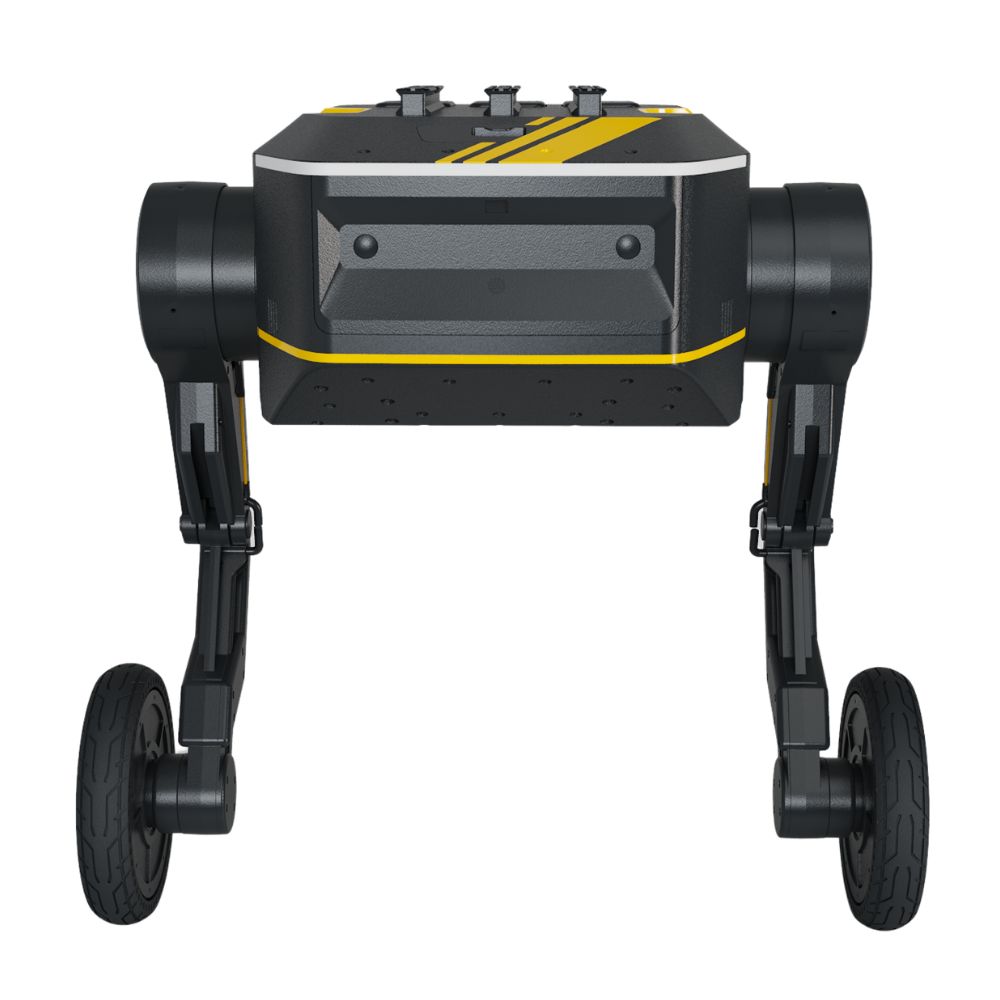
Wheeled-leg robots and AGVs serve different mobility needs. AGVs remain highly efficient for structured indoor logistics, with payloads often reaching 500–3000 kg and operating accuracy above 95% in controlled environments. Wheeled-leg robots provide greater terrain flexibility by combining wheels with leg mechanisms, allowing operation across slopes, steps, gravel, and mixed indoor-outdoor areas. The choice depends on terrain, payload, cost, and automation requirements.
The expansion of automated logistics, inspection, and industrial service systems has increased demand for mobile robots that can operate beyond flat factory floors. Traditional AGVs have been widely adopted since the 1950s for material transport, and modern systems achieve more than 95% positioning accuracy in structured facilities using LiDAR, magnetic guidance, or visual markers. However, many industrial environments now include outdoor loading areas, production yards, ramps, and uneven surfaces. In these locations, wheeled-leg robots provide an alternative approach by combining wheel-based speed with leg-based terrain adaptation.
AGVs are designed for predictable routes, while wheeled-leg robots are designed for changing environments.
The difference begins with mechanical structure. AGVs usually rely on four-wheel or differential-drive platforms, where continuous contact between wheels and the ground is required for stable movement. This design supports high payload transportation, with industrial models commonly carrying 500–3000 kg and running for 8–16 hours per battery cycle. Their simple structure reduces maintenance requirements and makes them suitable for warehouses, factories, and distribution centers.
Wheeled-leg robots use a hybrid architecture. They can move with wheels on smooth surfaces and use leg mechanisms when encountering steps, slopes, or uneven ground. Modern wheeled robot platforms integrate electric actuators, force sensors, and real-time controllers to adjust body posture during movement. Some research platforms have demonstrated climbing slopes above 30 degrees and overcoming obstacles 20–30 cm high, although their payload capacity remains lower than industrial AGVs.
The different mechanical designs create different terrain performance. Flat indoor environments strongly favor AGVs, while mixed environments increase the demand for adaptive mobility.
A warehouse floor and an outdoor industrial site represent two different operating conditions, even when the same robot performs both transportation tasks.
AGVs perform well when roads, pathways, and operating areas are carefully prepared. In a modern warehouse, autonomous vehicles can follow fixed routes, avoid workers, and coordinate with warehouse management software. Studies of industrial mobile robots show that structured environments allow navigation errors to remain within a few centimeters under stable conditions.
Outdoor terrain introduces additional requirements. Small changes in ground height, loose materials, or surface slopes can affect wheel traction. A curb of 10 cm may stop a low-clearance AGV, while a wheeled-leg robot can raise its body, adjust wheel contact, or step across the uneven section.
A comparison of typical operating conditions shows the difference:
| Feature | AGV | Wheeled-Leg Robot |
|---|---|---|
| Main environment | Indoor factories, warehouses | Indoor and outdoor mixed areas |
| Payload | 500–3000+ kg | Usually 20–200 kg |
| Flat-floor speed | 1–2 m/s | 1–3 m/s |
| Terrain adaptation | Limited | High |
| Navigation style | Route-based | Environment-based |
| Maintenance | Lower | Higher |
| Infrastructure needs | More preparation | Less surface preparation |
These differences affect where each technology is used. AGVs remain widely used for high-volume transportation, while wheeled-leg robots are being developed for inspection, outdoor delivery, and complex industrial locations.
Navigation technology also separates the two systems. AGVs typically depend on accurate maps and known pathways. Modern autonomous mobile robots use LiDAR, cameras, and software algorithms to detect obstacles, but their movement decisions are still strongly influenced by environmental structure.
Wheeled-leg robots require more advanced perception because the robot must understand terrain conditions before selecting movement patterns. A system may identify stairs, gravel, or uneven pavement through 3D sensors and then change wheel speed, leg position, and body height.
The robot does not only need to know where to go; it also needs to determine how to move through the environment.
Recent developments in artificial intelligence have improved this process. Reinforcement learning methods and sensor fusion algorithms have been tested on robotic platforms since the 2010s, allowing robots to learn stable movement patterns from large amounts of simulation and real-world data. In several research projects, trained controllers reduced walking adjustment time by more than 20% compared with manually designed control strategies.
However, navigation flexibility comes with higher technical complexity. Wheeled-leg robots require multiple motors, precise mechanical joints, and powerful computing hardware. A typical four-legged system may contain 12 or more actuated joints, while a conventional AGV may use only a few motors for movement and steering.
Energy consumption is another important comparison area. Wheels are highly efficient on flat surfaces because most energy directly contributes to forward movement. AGVs operating on smooth floors can maintain low energy consumption and predictable battery usage. Wheeled-leg robots consume more energy because leg movement requires continuous adjustment of position, force, and balance.
For large indoor logistics networks, energy efficiency and reliability often make AGVs the more practical option.
Payload capacity remains one of the largest differences between the two technologies. Automotive factories, electronics plants, and warehouses often require robots that move hundreds or thousands of kilograms. AGVs meet these requirements with heavy-duty chassis designs and industrial batteries.
Wheeled-leg robots currently focus on tasks where terrain flexibility is more important than carrying capacity. Typical applications include:
-
industrial inspection;
-
power facility monitoring;
-
outdoor warehouse transport;
-
construction site observation;
-
emergency response environments.
Commercial and research companies are developing wheeled robot platforms with improved sensors, stronger actuators, and longer operating times. Many current platforms still operate below 100 kg payloads, but improvements in materials and battery technology are expected to increase their practical applications.
Cost also affects deployment decisions. AGVs benefit from decades of industrial development, standardized components, and established maintenance systems. A factory can install AGVs with existing warehouse software and predictable operating procedures.
Wheeled-leg robots require more expensive hardware because each additional joint increases mechanical and control requirements. Sensors, actuators, and computing units contribute to higher manufacturing costs. A single advanced robotic platform may cost several times more than a basic AGV with similar transport speed.
However, cost comparisons depend on the environment. If a facility requires large investments in ramps, special roads, or surface preparation, an adaptive robot may reduce infrastructure changes. In locations with frequent terrain changes, flexibility can become more important than maximum payload.
Future industrial environments will likely use both technologies rather than selecting only one. AGVs will continue serving structured transportation tasks where speed, reliability, and carrying capacity are priorities. Wheeled-leg robots will expand into areas where robots must move between indoor and outdoor spaces without major environmental modification.
The development direction is moving from robots that follow prepared paths toward robots that can adjust their movement according to surrounding conditions.
By 2030, advances in artificial intelligence, battery systems, and robotic hardware are expected to improve the performance of adaptive mobile robots. The combination of wheel efficiency and leg mobility may allow more robots to operate across factories, campuses, warehouses, and outdoor facilities using the same platform.
AGVs and wheeled-leg robots represent two different approaches to mobile automation. AGVs provide efficient transportation in controlled spaces, while wheeled-leg robots provide greater flexibility in complex environments. Selecting the appropriate system depends on terrain conditions, payload requirements, operating time, and total deployment cost. For structured indoor logistics, AGVs remain highly competitive. For mixed indoor and outdoor terrain, wheeled-leg robots offer capabilities that traditional vehicles cannot easily provide.